2025 – Putting Instructional Design Roots Down at Cañada
My third year as Cañada’s Instructional Designer included some interesting changes, and also a better sense of stability in the role in the campus community. Faculty seem to be more familar with the role and the specific perspective that I can offer from this role.
I was out on maternity leave for part of the year, which brought wonderful additions to our team as we took on part-time Instructional Designers to cover my time. It was amazing to experience a bigger team that included more than one Instructional Designer, it made many more things possible.
This year I focused on doing as much as I could while accommodating the arrival of my second baby. Luckily our team picked things up while I was out and so we were able to continue our faculty support without any gaps in availability. When I wasn’t out on leave during my third year, I focused on:
🌳 Continuing to offer regular FTLCL workshops, focused on RSI and AI, our current hot topics,
🌳 Representing DE in campus governance on IPC and Academic Senate,
🌳 Updating our DE Handbook (for this first time in over a decade!)
🌳 Consolidating our web resources and connecting them to the Faculty Teaching & Learning Center and Equity and Anitraciscm Council.
Thank you for being here and all of your wonderful support!
Projects
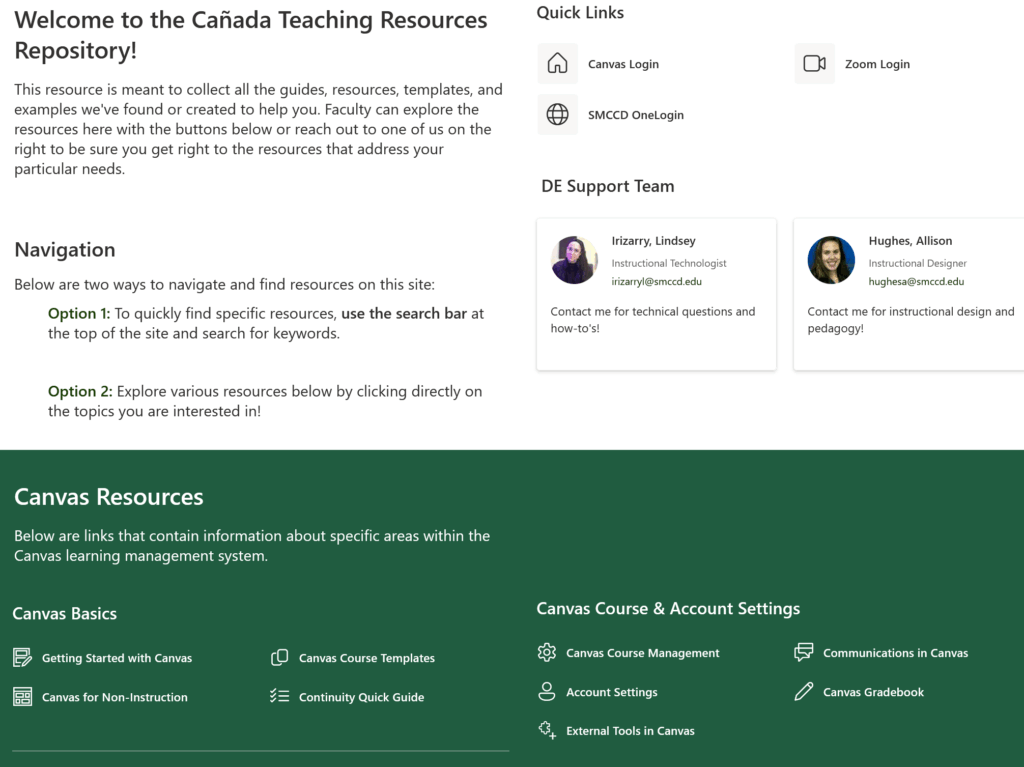
Website Consolidation & Teaching Resource Repository
We created a Faculty Repository on Canvas a few years ago, but having it in Canvas seemed to be to out-of-the-way. We also had many guides posted across multiple websites. Having resources in so many different places made it difficult to manage as a larger team, and difficult for faculty to find all of the information they’re looking for.
I decided to consolidate our websites and I proposed merging them with the Faculty Teaching & Learning Center website, so that faculty can find all of their teaching and learning support information in one place. I collaborated with our Instructional Technologist, Faculty Teaching & Learning Center Coordinator and Equity and Anitracism Coordinator to get this project up and running and we all contributed to compiling, creating and updating resources there.
I also worked with our Instructional Technologist to re-create the Teaching Resource Repository over to SharePoint and to begin building it out. We’re continuing to work on adding to and updating the Repository and that work is ongoing.
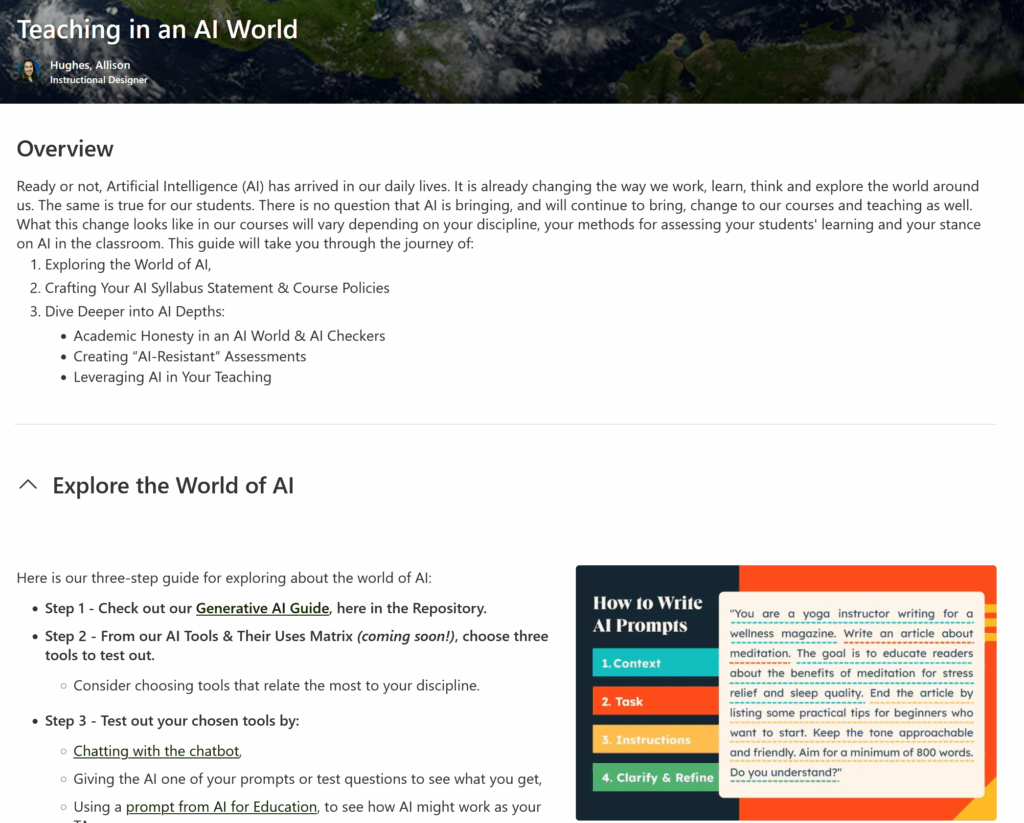
Ongoing Repository Work: Teaching in an AI World Guide
As an example of ongoing work on the repository, I began to build out the AI section of the Resource Repository. I started with a Teaching in an AI World Guide, walking faculty through the beginning stages of exploring and experimenting with AI.
I pulled together resources that were already being shared throughout the District and I created resources for some areas of teaching with AI that we didn’t already have. My goal was to give faculty a simple path to starting to work with AI without overcomplicating the topic and without contradicting the existing AI guidance available in the District.
Academic Senate RSI Resolution
In order to institutionalize the best practices outlined in the ACCJC standards around RSI, we proposed the Resolution of Support for Aligning DE Courses with Regular and Substantive Interaction (RSI) Standards.
While the resolution was a timely addition to our ACCJC visit documentation, our goal was to have the best practices for RSI implementation institutionalized for our online course design standards beyond accreditation review.
I brought the first draft of the resolution to Academic Senate on 9/11. Academic Senate formed a writing group to address the feedback generated by the committee and our team met with writing group, and then I brought back the edited version on 9/25/25 and the resolution was adopted.
Faculty Service
Workshops
RSI and AI have been our two hot topics this year and that has been the focus for most of my Faculty Teaching & Learning Center workshop offerings. We’ve had some great engagement in our sessions and I’m going to continue collaborating with the FTLCL Coordinator and Flex Coordinator to offer regular sessions that align with faculty interests.
2025 Sessions
- 1/10/25 – Unpacking the UDL Toolbox – Engagement Principle
- 1/10/25 – RSI Session on the New ACCJC Rubric
- 1/20/25: Using Pronto to Level Up Communication and Student Engagement
- 9/17/25: Strategies for Creating ‘AI-Resistant’ Assignments
- 10/22/25: Instructional Technology & Design Q&A
- 10/28/25: Directing AI Traffic – Create and Update AI Policies for Our Courses
Upcoming Sessions
- November & December Sessions on Creating OER Materials
- Syllabus Drop-In Labs in December
- January 2026 Flex – How to Support Student Technology Needs
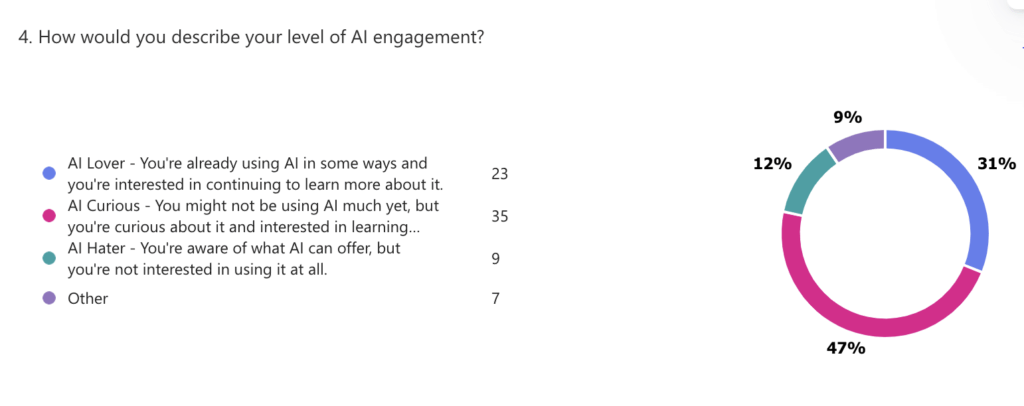
AI Temperature Check Survey
When I came back from leave in the Fall of 2025, I was hearing so many questions about AI and so many requests for trainings and support.
I started scheduling workshops with the Faculty Teaching & Learning Center, but I wanted to include Cañada faculty examples of things like AI course policies and examples of how faculty are using AI in their courses. I also wanted to get a sense, a temperature check, for how faculty are feeling about AI in general.
I put together the AI Temperature Check Survey and got some wonderful information and examples from faculty that I was able to include in my AI-Resistant Assignments workshop and AI Course Policies Workshop.
Next Steps for Faculty Support
Consultations were very quiet after I returned from leave. I think this was due in part to my limited availability being back part time and also to our focus and emphasis on preparing for RSI Review. We were able to engage with 95% of our online faculty who will be eligible for RSI Review, which was a huge feat and really important accomplishment.
Beginning in the Spring of 2026, I want to put a greater emphasis on increasing the number of consultations that I have in the 26-27 academic year, and I’d also like to see how we can increase drop-in attendance in our Instructional Technology & Design office hour sessions. I often see the same faculty reaching out and getting on my calendar who I often meeting with and chat with, I’d like to see if we can engage with other members of our faculty community. Some next steps in increasing our Faculty Support include:
- Communication Plan – now that our team is established and we’ve worked through three years together, I want to outline a communication plan for each academic year where we can be more consistent and clear with how we’re communicating with the campus.
- Division Tours – visit division and department meetings with support offerings more often throughout the year, and consider bringing an FAQ or Hot Topic to each visit.
- Instructional Design Survey – I did an instructional design survey during my first year in the role, and it might be time to re-do the survey and see what’s changed.
- Retreats – Because we have a few complex topics that are on our horizon right now, AI, Accessibilty and a new POCR Rubric, it might be helpful to host some faculty retreats to support folks in these areas.
Campus Service
DE Handbook Update
The Distance Education Handbook was last updated in the Spring of 2014. We have finally updated our DE Handbook in the Fall of 2025.
The Instructional Technology & Design Team and DEAC collaborated to work on updated draft and I was able to finalize that draft and bring it to IPC and Academic Senate for approval.
We incorporated a lot of great feedback from the two committees and we were able to get the final draft approved by IPC on 10/17/25 and by Academic Senate on 10/23/25. We were able to get this document approved and included as part of our evidence for the ACCJC ISER.
We will continue to improve and update this document, and also share it again as a resource for the campus community to find all of our processes, recommendations and resources in one place.
DE Annual Update
We submitted a simple annual update in order to continue to request budgets for QOTL and POCR so that we can continue to support faculty in their continuous work of updating online courses.
In preparing our Annual Update, I reviewed the feedback we received from IPC on our comprehensive review last year. They gave us some great feedback and asked some really interesting questions. I gathered our IPC feedback together and requested to share them at an upcoming DEAC meeting. That discussion will be really helpful in checking in on what direction we’d like to move in next.
Continued Committee Work
IPC, District DEAC and Technology Committee
I’ve continued to serve on several committees in my role as the Instructional Designer. I’ve been glad to represent our team’s initiatives, like RSI, in these spaces to ensure misinformation is not running away from us. I’ve also participated in conversations around preparing for our accreditation visiting team’s access to Canvas, aligning of our SLO assessment, program review and accreditation standards, and participating in our District’s AI Community of Practice.
Professional Development
🪴
- Even though I was on leave for much of this year, I made sure to fit in some professional development oppurtutunities where I could. With so many big changes coming to our team in the next year, I was glad I made the time:
- Webinar: Prepping Like a Pro – Setting the Stage for a Great Learning Experience
- This session was such a great way to get my brain back into instructional design strategy after being out on leave. I took away multiple strategies that I want to share with faculty and add to our Teaching Resource Repository.
- Webinar: CVC-OEI POCR Rubric Listening Session
- I attended this session which outlined the much needed changes coming to the POCR rubric in the Fall. I’m looking forward to basing my workshop and project planning for the Spring and Fall of 2026 on these upcoming changes.
- Virtual Conference: Instructional Designer Professionals Conference
- This is my second time attending this conference and I always walk away with a broader instructional design perspective from being in sessions with Instructional Designers from across the country and the world. Some thoughts from this year’s sessions:
- How do the environmental impacts of AI differ or align with the environmental impacts of all of our digital activities? How do these impacts intersect with our students’ need to learn to use AI?
- Invert Bloom’s Taxonomy for More Authentic / AI-Resistant Assessments
- Use the FRAME framework for ensuring that updates to SLOs are aligned with academic methodologies and not personal beliefs or political identities. Dive deeper into Academic Freedom meaning, history and applications.
- Centering well-being at the heart of our course design strategies could save students lives: suicide is the second leading cause of death in undergrads, and young adults aged 18-24 self-report at 40% rate of loneliness as compared to 10% in 1976.
- This is my second time attending this conference and I always walk away with a broader instructional design perspective from being in sessions with Instructional Designers from across the country and the world. Some thoughts from this year’s sessions:
- Webinar: Prepping Like a Pro – Setting the Stage for a Great Learning Experience
Future Professional Development Plans
- Obtain my UDL Credentials
- Attend the Online Teaching Conference
- Update POCR Reviewer Certification with new rubric